

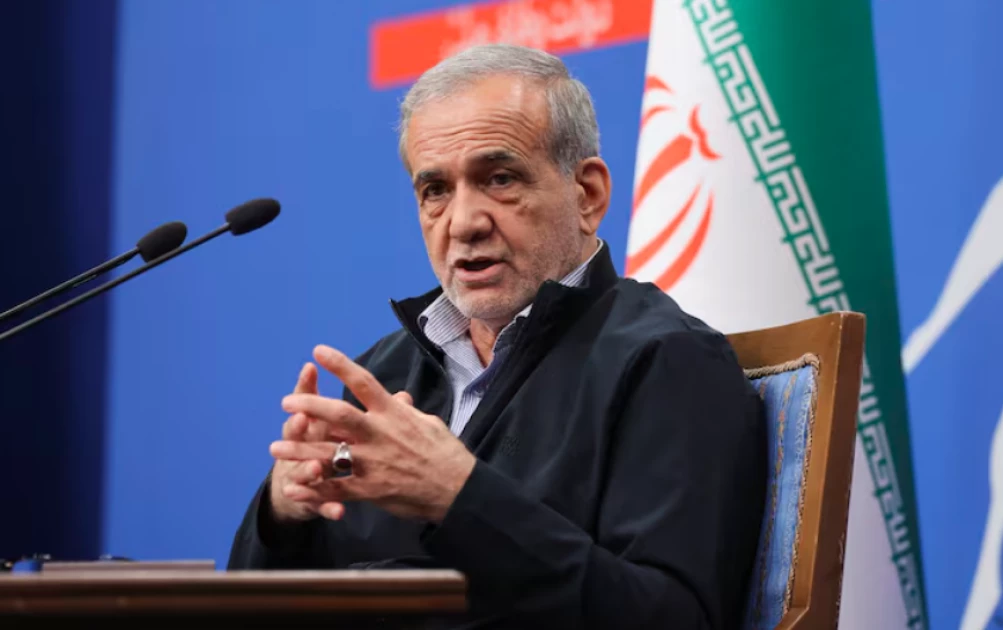
Iranian President Masoud Pezeshkian at a press conference in Tehran, September 16, 2024.
By Brian Angwenyi, Oyominto TV.
Iranian President Masoud Pezeshkian has delivered a defiant message to United States President Donald Trump, declaring that Iran will not surrender to American pressure.
Speaking at the United Nations General Assembly in New York on Wednesday, Pezeshkian said Iran was prepared for dialogue and negotiations, but would not accept what he described as the language of force.
His remarks came a day after President Donald Trump warned that the United States could “annihilate” Iran if a peace agreement was not reached.
Pezeshkian accused Washington of adopting what he called a “bullying mentality” and said increased sanctions and military pressure would only strengthen the Iranian people’s resistance.
He declared that Iran would “never bow our head or bend at the knee.”
The Iranian president also defended his country’s position on its nuclear programme, maintaining that Iran’s nuclear activities are peaceful and insisting that Tehran would not accept foreign pressure to impose limits on its programme.
At the same time, Pezeshkian said Iran remained open to diplomacy.
Iranian officials have indicated that messages have been exchanged with Washington through Qatari mediators, although the two sides remain far apart on the conditions for ending the conflict. Tehran has called for an end to the war and the lifting of the US naval blockade on Iranian ports.
Another major issue is the Strait of Hormuz, one of the world’s most important energy shipping routes.
Iran has linked the reopening of the strategic waterway to a reduction in US military pressure and the lifting of the blockade on Iranian ports. Any prolonged disruption in the Strait could have wider consequences for energy supplies and global markets.
The exchange between Trump and Pezeshkian comes as the conflict between Iran and the United States continues, with Israel also involved in military operations against Iran.
Despite the harsh public statements from both sides, diplomatic channels remain open.
US Secretary of State Marco Rubio has said reaching an agreement with Iran would require significant work over time, while Iranian officials say diplomacy can resume if Washington takes concrete steps toward ending the conflict.
For now, the two countries remain sharply divided, with Iran insisting it will not surrender under pressure while the United States continues to demand major changes from Tehran.
The international community is closely watching the situation, particularly because any further escalation could affect security in the Middle East, energy supplies and global trade.
Comment here